
'%20id='ico-down'%20stroke='%23000000'%20stroke-width='1.5'%3e%3cg%20transform='translate(1092.250000,%20254.750000)'%3e%3cpolyline%20id='Path-2-Copy-4'%20transform='translate(5.500000,%202.750000)%20scale(1,%20-1)%20rotate(-180.000000)%20translate(-5.500000,%20-2.750000)%20'%20points='0%200%205.5%205.5%2011%200'%3e%3c/polyline%3e%3c/g%3e%3c/g%3e%3c/g%3e%3c/svg%3e)


Education
Language Learning
French language schools
Looking to learn French before or after you move to the country? Here’s all you need to know about French language schools, courses, apps, and more.

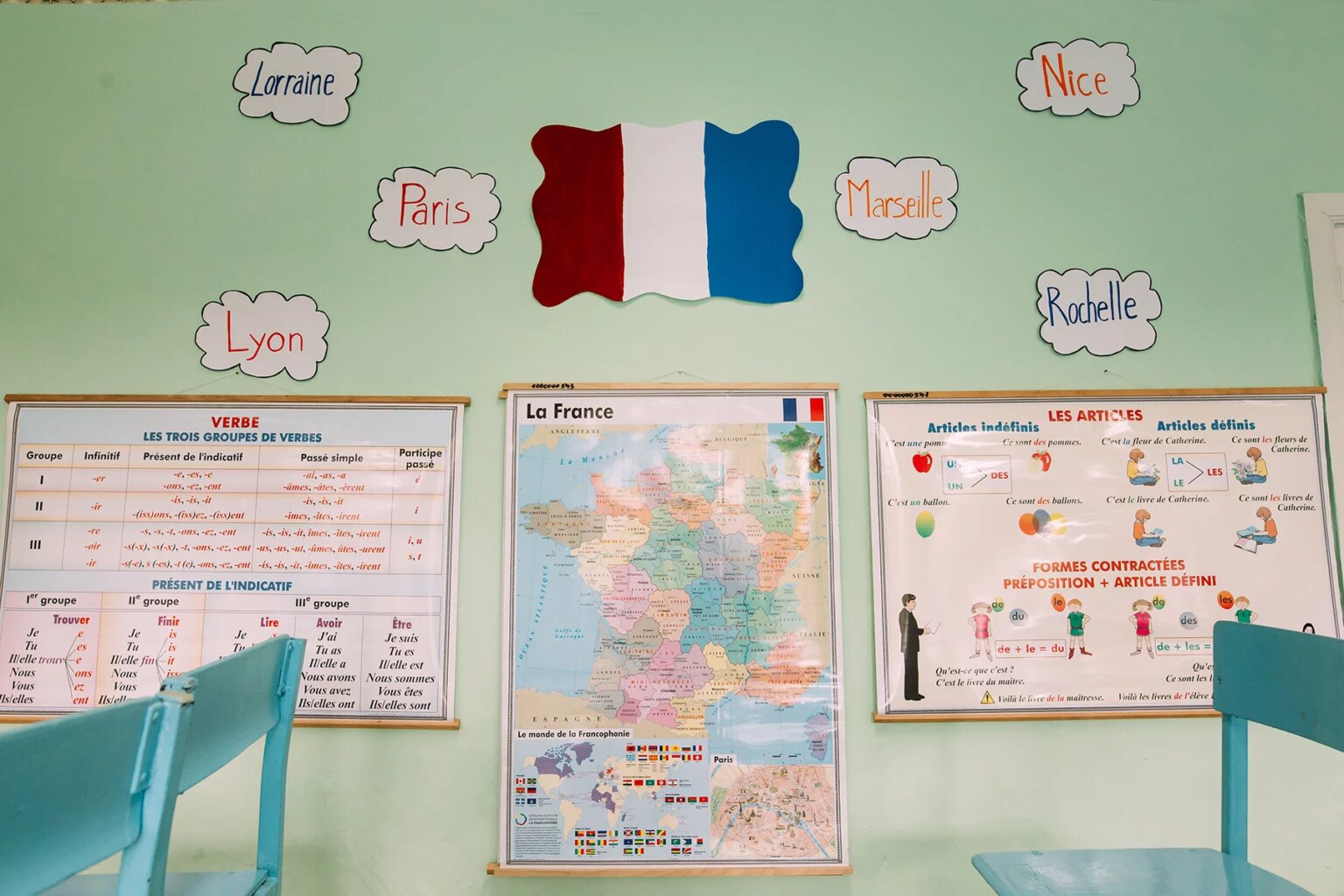
Naturally, the best way to perfect your French is by immersing yourself in the language while living in France. And fortunately for expats considering making the move, relocating to the country and arranging a visa is not as difficult as you might think. This is particularly true if you are looking to study in France.
However, aside from immersion, there are many other ways to learn the lingo, either before or after you land on French soil. In addition to the many French language schools which offer courses for beginner, intermediate, and advanced level students all over the world, there are numerous online courses, apps, and language exchanges to help you along the way, too.
To give you an idea of your options, this guide covers the following topics:
Preply
Immerse yourself in the language of your new country with Preply. This app and website matches learners with online tutors so you can follow live, personalized language classes. With 50 languages to choose from, and tutors all over the world, there’s a course for everyone. Check out Preply to start your language-learning journey today.

Why learn the French language?
French is the fifth-most widely spoken language in the world and there are currently around 274 million native speakers across the globe. It is also one of the main languages of diplomacy and international relations and remains one of the official languages of the United Nations (UN).

Naturally, if you are moving to France, there are numerous benefits to learning the language:
- Career prospects: it will be easier to communicate with colleagues and clients, find a job, and progress in your career
- Social life: you’ll be able to meet more people, explore the local dating scene, participate in more activities, and feel less isolated
- Integration: it will provide better access to French culture, books, news, magazines, and French TV, and make you feel part of your community
- Legal requirements: if you stay in France for longer and decide to apply for citizenship or a resident card, you may need to prove that you can speak French
- Personal development: Every language you know will broaden your knowledge and open doors that you didn’t even know existed

The good news for expats is that French is not the most difficult language to master. In fact, it is possible to gain basic fluency after taking between 600 and 750 class hours. This is similar to the time that it takes to learn Dutch, Spanish, and Italian, but easier than German (750 hours) and significantly more manageable than the 2,200 hours required for Arabic, Mandarin, Japanese, and Korean.
Learning French before moving to France
While the fastest and most enriching way to learn French is by living in France or immersing yourself in a French-speaking environment, it’s never a bad idea to get a head start before you move. Therefore, you may want to search for some introductory French courses at your local university or French cultural center before moving to France.

Other ways to learn French include finding a language exchange partner, watching language videos online, downloading a language app, or watching French films to train your ear. That way, you’ll feel less daunted when you arrive in France and be more excited to try out your new language skills.
International French language schools
Of course, you can look for a language school that has locations in both France and your home country. That way, you can easily continue to learn the language after you move. A few institutes have language centers across a number of countries. Below are some that you might want to look into.
- Alliance Française – has a global presence and offers French language resources, classes, and examinations across 132 countries
- Berlitz – has seven centers the US as well as 16 language centers across France, offering classes in a variety of different settings; ranging from group classes to private, one-on-one lessons
- International House World Organization – represents a global network of affiliated language schools across 52 countries, of which 49 teach French
Aside from these, most language schools in your country of origin will offer French since it is so widely spoken around the world. Below are some options that you can explore, depending on where you are based.
- If you are in the UK, a few language schools worth looking into include Cactus, Bond Street Languages and International House
- In Canada, there is BLI in Quebec City and ALC in Montréal. The government of British Columbia has an extensive list of classes available in the province.
- In Germany, you can check out Alpadia in Berlin
- And if you are in the Netherlands, language institutes such as Bogaers and Una Paloma Blanca offer French lessons to get you started
The online search portal, Language International, can also help you find hundreds of French language schools around the world.
Where to learn French in France
There are many benefits to learning a language in the country where it is spoken. For instance, you will:
- Have a wide choice of classes: from intensive French courses to conversational French lessons and French summer courses
- Learn real, everyday French: you can learn French in natural settings by having class outings to museums, markets, and other places
- Grasp the nuances of the language: by picking up on the different types of French slang, expressions, phrases, and accents
- Learn French quicker: as you can easily practice outside the classroom and absorb the language passively throughout the day
- Have informal learning opportunities: such as free conversation evenings, language exchange events, and state-subsidized classes
Language schools in France
There are many options when it comes to finding a language school in France. Below is a small selection of some of the country’s most renowned institutions that are located throughout the country.
Alliance Française
The well-known international language institution, Alliance Française, has 30 branches in France. It is dedicated to promoting French globally via classes, cultural activities, and French certification. The institute offers different packages to combine general French lessons with other classes – such as workshops or personalized programs – to create a French course that is adapted to your needs, availability, and objectives.
Locations: There are 20 language centers and six cultural centers located across France. You can use this interactive map to find one near you.

Azurlingua
Azurlinga is FLE accredited (Qualité français langue étrangère) and approaches French language learning from a practical perspective. It offers French language exam preparations and courses for a specific purpose, such as business, medical, science, tourism, or university integration. Its purpose is to teach you to acquire varied knowledge while rapidly developing your communication skills in French. Teachers are all native French speakers and university graduates.
Locations: Nice
Berlitz
This international school offers French language courses in 16 centers across France. Teaching can be done privately or in groups, and Berlitz teachers can even come to your office.
Locations: Arras, Bordeaux, Dunkerque, Grenoble, Le Havre, Lille, Lyon, Marseille, Nantes, Paris, Rouen, Strasbourg, and Toulouse
Eurocentres
Eurocentres offers a wide range of French language courses designed for students seeking to learn French at different levels. Courses vary from two weeks to a year.
Locations: Amboise, La Rochelle, and Paris
France Langue
With five schools located in mainland France (and one in Martinique), France Langue provides lessons for all general and specialized French levels (such as business, legal, and medical), as well as French teacher training and language exam preparation.
Locations: Paris, Nice, Bordeaux, Biarritz, Lyon, and Martinique
Aside from exploring what French language schools might be located in your local area, you can also check which universities offer French courses.
Government-run French lessons in France
Suppose you want to access more affordable or free French lessons. In that case, it’s best to contact your local town hall (mairie) to see what is available in your area. The local authorities may organize classes for foreigners or point you in the direction of local associations.

For example, the Mairie de Paris sometimes opens up French courses for adults. If you’re unemployed, you can also ask about French classes when you register at your local Pôle Emploi job center.
The Interior Ministry has also set up MOOCs (massive online open courses) called Vivre en France in partnership with Alliance Française. These cover levels A1 to B1 and are available once you register online.
The French government also funds French lessons for internationals who have worked in France for at least one year. These courses are called FLE, which stands for Français Langue Etrangère or French as a Foreign Language, and are accessed through your Compte Personnel de Formation (CPF). For each year of work, you can access €500 worth of language training. There are different bodies that offer such training, including online training from Clic Campus.

Meanwhile, Parlez Vous Français? and Alliance Française offer both e-learning and classroom learning options. It might also be worth seeing if your employer provides other funding schemes or partnerships with local institutions to help employees learn French.
Learning French for free in France
If you are self-motivated, you can find an enormous amount of language-learning resources to help you master French for free. You can read on to find out more about that. Meanwhile, local associations and charities such as Croix Rouge (French Red Cross), La Cimade, and Secours Catholique often offer free or low-cost French lessons for newly arrived immigrants.

However, just bear in mind that these classes are usually not as intensive as they are in language institutes and teachers are not necessarily as experienced. If you’re in Paris, the Secours Populaire also lists relevant associations and institutes in the city.
It is also a good idea to sign up for local language exchange sessions where you can practice your French for free. Sites like Meetup tend to have plenty of language groups and events in all the major cities. You can also explore the local Facebook groups in your area to find some.
A visit to your local library could also prove to be helpful since many provide free language learning resources and sometimes organize conversation groups or language events.
Learning French online
Whether you want to learn French in France or before you move, there are plenty of ways to master the language online. From enrolling in online courses and watching language learning tutorials to downloading language apps and podcasts, you are sure to find a method that suits your learning style. Below are some options that you might want to explore.
Online French courses
If you like to learn within a virtual classroom environment, there are numerous online language course providers, some of which we have previously mentioned. Most institutes and schools now offer e-learning options, ranging from highly intensive and needs-specific classes held over a few weeks, to more slow-paced learning over a year or more.
You can usually sign up for online classes with a personal tutor or small groups. Of course, prices vary depending on the course you choose and the level of support that comes with it.
Here are a few options you might want to explore:
- Parlez-vous French – offers intensive beginners’ lessons for five hours per week for four weeks at €149
- Alliance Française – has a package of online classes for nine hours per week starting at €472 per month
- Berlitz – options include a self-paced online course with a cyber teacher, starting at around €270 for six months
- italki – gives access to network of French teachers for 1-to-1 lessons., with hourly rates to meet your budget
- LanguaTalk – find a French teacher for 1-to-1 lessons online at a time that suits your schedule
- Lingoda – has four course options, from ‘Maintain’ at €48 for four 60-minute classes per month, to ‘Immersion’ at €320 for 40 classes
- Preply – is an app that offers live, online courses with tutors all over the world
Digital resources
If you prefer to take things at your own pace, there are plenty of useful online resources to help you develop your French skills. The diverse range of media also means that you can choose one that suits your learning style.
Here are just a few options to check out:
- BBC – has an interactive platform with everything from mini-lessons to a 12-week course
- Coffee Break Languages – offers access to short audio French language learning tutorials, which are downloadable as podcasts
- TV5Monde Apprendre le français – an interactive website where you can learn French through videos, with over 2,000 exercises
- Le Point du FLE – has over 15,000 links to support students and teachers of French as a Foreign Language (FLE)
- Le Plaisir d’apprendre – set up by Alliance Française, this platform for teachers and students includes phonetics, written and oral comprehension, and delves into French history and culture

It can also be handy to use an electronic translator, such as Word Reference or Google Translate when you’re out and about in your new home country. The latter can even directly transcribe and translate speech to help conversation flow while you are still mastering the language.
Language learning apps
If you want to casually learn French, then downloading a language-learning app can be really useful. However, everyone learns differently, so make sure you pick one that suits your learning style.
Here are a few popular ones to get you started:
- Babbel – a highly-rated language app with short, interactive lessons
- Berlitz Talk & Travel – one app for 17 languages, including French, with an integrated menu reader to help when you are eating out abroad
- Bonjour! – focuses on conversation-style learning with hundreds of dialogs that you can apply in daily settings
- Brainscape – based on flashcards, repetition, and quizzes
- Busuu Learn French – helps you learn the basics of French with 3,000 words covering 150 topics, includes games and quizzes
- Duolingo – a very popular app with bite-sized daily lessons and an attractive interface
- FluentU – encourages language learning through real-world videos
- Fluenz French – this is specifically designed for English speakers who want to learn one of six languages, including French
- Mondly – it’s all about fun and games with this app that is both educational and addictive
- MosaLingua – provides you with a virtual French language coach to get you up to speed on your basic French
- Pimsleur – enables language learning based on the well-established Pimsleur Method; a series of audio courses that focus heavily on auditory and verbal perception
- Rosetta Stone French – these well-known digital courses are now also available as an app
Language learning programs
Many companies claim to have the best online French lessons for learning quickly and retaining information. Many offer virtual classes, apps, and language learning programs, so you can sign up and combine them for the full experience. You can always start with a free trial, but beyond that, prices vary.
Here are some options and prices to consider:
- Babbel – grants you premium access to all French lessons and personalized courses from €4.99 per month
- Brainscape – an online and mobile collaborative learning platform based on flashcards, repetition, and quizzes for US$5 per month
- FluentU – enables French immersion online through videos and quizzes starting at US$19.99 per month
- Fluenz French – a self-described serious program that costs US$398 for full access to all levels
- Mondly – an online platform that is visually engaging as well as educational; you can sign up and learn French for €9.99 per month
- Plimseur – the complete Premium French course costs US$575 for 80 hours
- Rocket Languages – the full French immersion course package costs US$259.90 for 422 hours of lessons
- Rosetta Stone French – a well-regarded company with over 25 years of experience and a program that includes speech recognition software. Prices start at US$7.99 per month or US$179 for a lifetime of unlimited access to its language-learning software.
Practicing French outside of the classroom
When living in France, there are ample opportunities to learn French outside the classroom in your day-to-day life.
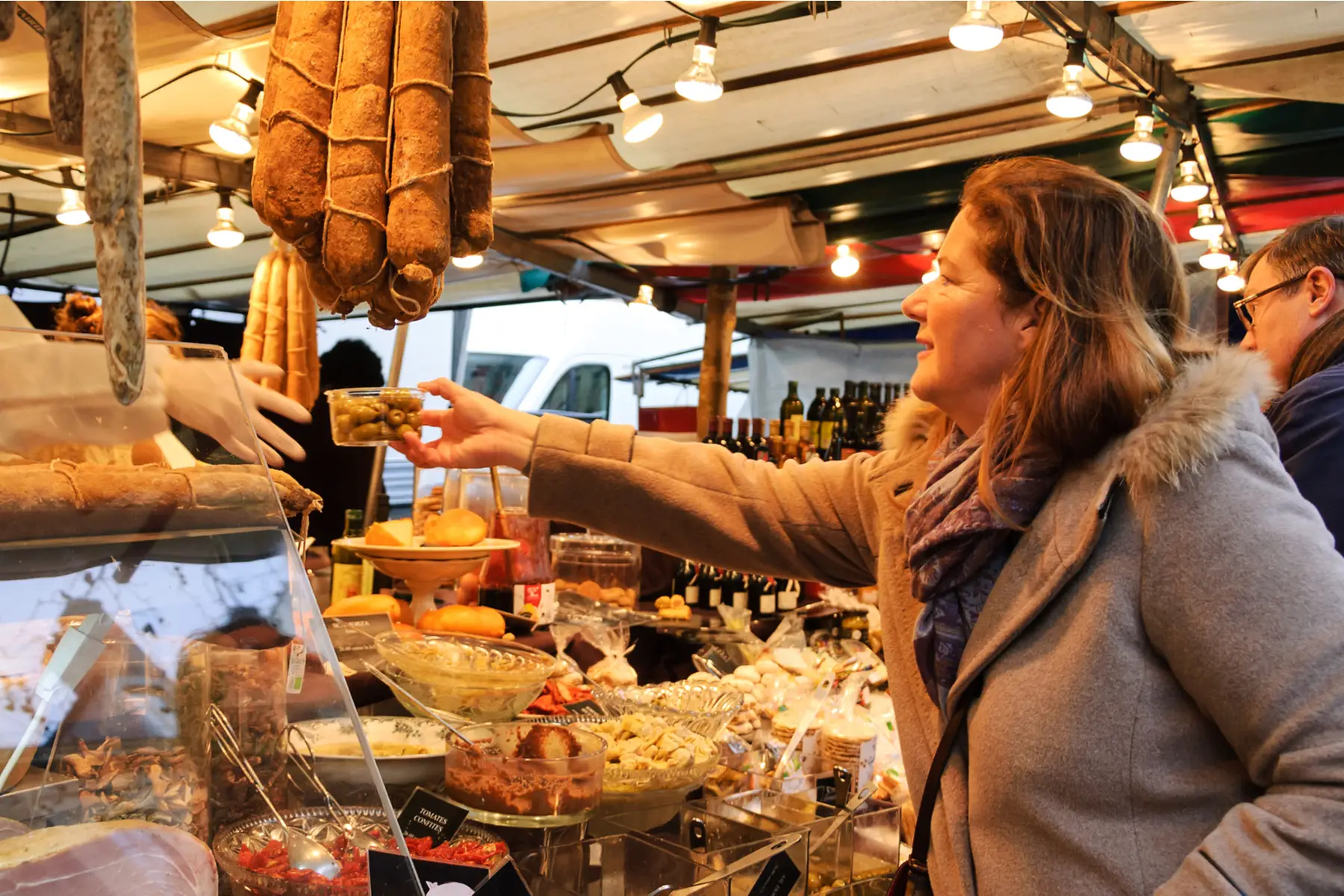
Here are a few examples of what you can do to improve your language skills each day:
- Get chatting: interact with your neighbors, local shop owners, other school parents, market vendors, or bartenders. Don’t be shy about your desire to practice and improve your French.
- Host playdates: hanging out with French-speaking children will organically teach you all the basic vocabulary – and they won’t judge your wonky grammar and pronunciation, either!
- Join a local sports club or association: explain to people that you are eager to learn and apologize in advance for any mistakes you make.
- Be persistent: speak only French with your new friends and colleagues.
- Watch French TV and films (with subtitles): eventually, you can turn the subtitles off and see how much you understand without them.
- Read French newspapers: start with free, local papers; the articles are short and give you insight into your local community.
- Visit exhibitions and museums: pick up a French audio guide to accompany you and learn some vocabulary along the way.
- Join a language exchange: join local cafés polyglottes or language exchanges near you on sites like Meetup, Polygot Club, and BlaBla Language Exchange.
Learning options for children
If you enroll your child in a French school in France, they may receive linguistic support and extra language lessons. However, not all schools have the resources for a special teaching assistant. Therefore, it’s good to develop their knowledge of French before they even start school.

Some of the online resources mentioned above will also provide options for young learners. For example, Berlitz has online classes for children and teens with groups of three to six learners.
Notably, children will likely be more receptive to language learning if it’s presented as a game or other interactive activity. And fortunately, there are plenty of language learning apps for children that include these. You can check out some of the apps below or search for others that are suited to your child’s age, level, and personality:
- French Learning For Kids – learn the French alphabet, numbers, and words by popping balloons, coloring pictures, and doing puzzles
- Gus Learns French – join Gus, the friendly owl, as he travels around the world and explores languages from every corner of the globe
- Boukili – an immersive, interactive, and educational reading experience for children aged 4 and up
- Studycat: Learn French for Kids – for learners from 3 to 8 years, with two themed courses (colors and animals) and 14 language lessons
- Bonjour! French for Kids and Beginners – mini learning games designed for both children and adults, making it easier to learn and memorize vocabulary
Of course, you can also borrow easy-to-read French books from your local library, and organize playdates with other children so they can learn the language while they socialize.
Official French language examinations and qualifications
There are four main French-language certifications:
- DILF (Diplôme initial de langue française): an A1.1 evaluation for beginners that is only available in France
- DELF (Diplôme d’études en langue française): up to B2 level, which is the level you need to access higher education courses in France
- DALF (Diplôme approfondi de langue française): up to C2 level, the most extensive test of your oral, writing, and reading comprehension skills
- TCF (Test de connaissance du français): tests your current knowledge of French and the certification is only valid for two years. You might need to sit a specific TCF test for a residence permit (CRF test) or French citizenship (ANF test).
Each level of exam costs roughly between €100 and €150, and more than 1,200 test centers around the world (including over 200 in France) issue these certificates, which people need for university applications, employment opportunities, and immigration statuses. Most universities and many language institutes in France also issue these certifications. Whether you are in France or abroad, you can find an exam center near you with this handy interactive map.
To determine your French language level and which certification might be best suited to you, you can complete an online assessment on Ev@lang, a platform set up by the French Ministry of Education.
Useful resources
- Ev@lang – an official online testing platform to help you evaluate your French language level
- France Education International – provides information on all the French government initiatives to encourage French learning around the world
- Ministère de L’intérieur – a portal for the Interior Ministry’s MOOCs (massive online courses)
- Mon Compte Formation – allows you to search for French training centers and remote learning courses subsidized by the French government



Did you find this guide helpful?